Today’s algorithms prioritize relevance and engagement over follower count, meaning only a small percentage of your followers will see any given post. This is particularly true if you are not putting any money behind the post to ensure its reach.
This matters for all brands and businesses — but the way reach works (and how you should respond) looks very different for B2B vs. B2C organizations posting in social media.
Below, we’ll share the current organic reach benchmarks, explain why reach is limited, and share platform-specific recommendations tailored specifically for B2B and B2C brands posting to social media channels.

Average Organic Reach Benchmarks (Unpaid Posts)
Across industries, sources agree that today’s realistic expectations for organic reach in social media business accounts continue to decline. Based on the averages we’ve seen, the percentage shown next to each platform is the number of followers we believe you can expect to see any given (unpaid) post:
- Instagram: ~3–6% of followers
- Facebook Pages: ~1–2% of followers
- LinkedIn Company Pages: ~1.5–2% of followers
Individual results will certainly vary based on engagement quality, audience behavior, and content format. As you can see, these percentages are very low, making organic posting (without added dollars to support a post’s reach) seem almost silly to spend time or money on. Below, we will continue to explain why organic posting is still relevant even though reach is limited, and what you can do to help increase the number of people who see your content.
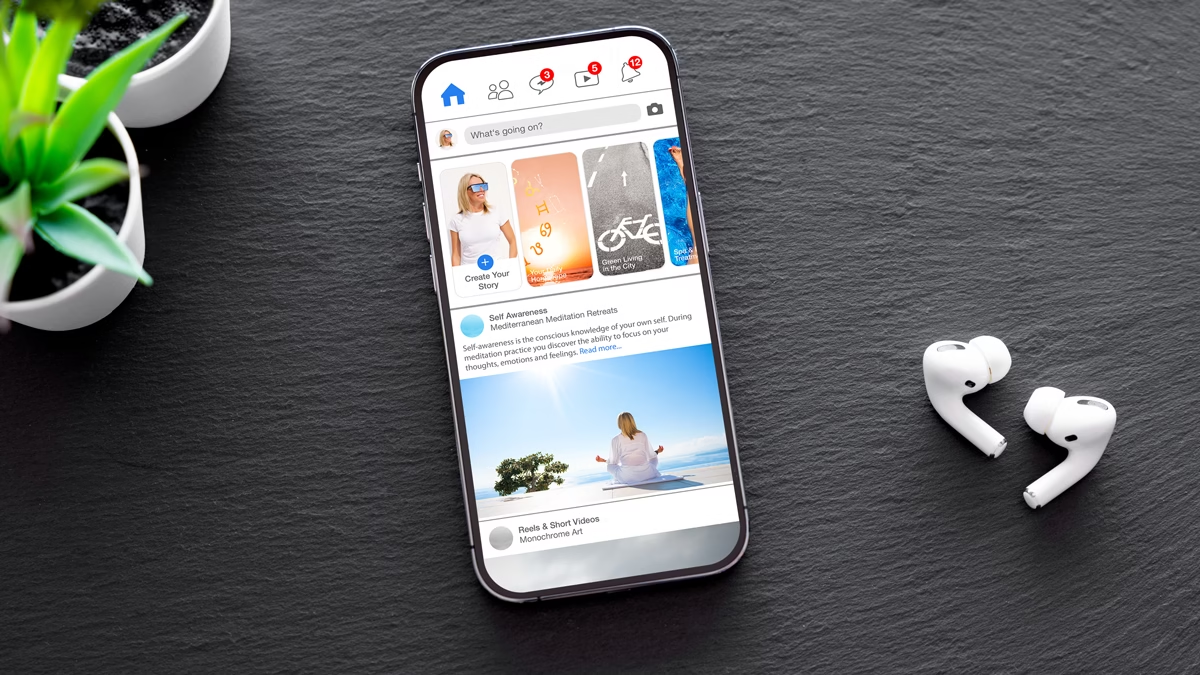
According to Meta, “organic reach is inherently limited by feed competition and personalized ranking.” While Meta does not disclose a specific reach percentage, the structure of Meta’s News Feed means businesses should expect only a small subset of followers to see any individual unpaid post.
What Meta does confirm (that directly impacts expected reach) is that the supply of content vastly exceeds what users can see in a given session. Meta explains that each time a person logs into Facebook, there are approximately 1,500 potential stories competing for placement in a user’s News Feed. And up to 15,000 potential stories for users with many friends and Page likes. However, only approximately 300 stories are actually shown in the user’s News Feed per session.
What are the Implications of this for businesses?
Clearly, following a business’s Page does not guarantee visibility. A Page’s post must compete against:
- Friends’ posts
- Group content
- Other Pages’ posts
- Recommended content from Meta
- Paid content (ads and boosted posts)
Meta also rejects the assumption we are all making that organic reach decline is attributed to monetization. Instead, they claim that the decline in visibility is more appropriately attributed to:
- Massive growth in content creation.
- Users liking 50% more Pages year over year.
- Finite attention and limited Feed space.
While we agree that these factors do play a role, there’s no doubt that spending money on the platform to ensure visibility by your Page’s followers or prospective followers solves the problem, so assuming there is no connection seems naïve in today’s day and age.
Why Organic Reach Is Limited (Across All Platforms)
The easy answer is that, like all digital media platforms, Facebook, Instagram (Meta), and LinkedIn are pay-to-play environments. Free for users (individuals or businesses), these platforms are definitely not free for businesses who want any sort of guarantee that their content will be seen. Meta states that their “current algorithms are designed to protect user attention.” And, that “content earns distribution based on predicted relevance, not posting frequency.” So, more is not necessarily better.
Instead, value (in the form of visibility to followers) is placed on these common ranking factors:
- Early engagement velocity (especially comments, shares, and saves).
- Dwell time (how long users pause to read or watch).
- Prior interaction history with your account.
- Content relevance signals and topic affinity.
- Negative feedback (fast scrolling, hides, “not interested” actions).
Reaching New & Interested Audiences (Organically)
Without a doubt, putting some money behind your most important posts on Meta and LinkedIn will guarantee more visibility. Additionally, this will allow you to reach outside your follower base to reach new, geographically and demographically targeted users. But, if you’re looking to stick with only or mostly organic posting for the time being, here are some tips on getting the most from your time and effort.
Across all of the social media platforms, high-performing organic content is often tested with behaviorally similar users. Here are some ways to expand your Page’s reach without heavy ad spend:
- Prioritize formats designed for discovery (Reels, short video).
- Encourage employees, partners, and customers to engage and share your posts early and often.
- Collaborate with aligned brands or creators by sharing and tagging each other’s content.
- Support top-performing organic posts with light paid amplification.
How to Reach New, Look-Alike, and Interested Audiences (Without Big Ad Spend)
Organic reach doesn’t stop at your followers — if content performs well, platforms will test it with behaviorally similar users. Here are some recommendations by business type and platform:
- Use Reels and carousels for discovery and saves.
- Focus on shareable content (tips, humor, relatable moments).
- Write captions that invite opinions or choices.
- Encourage saves and Story shares (key reach multipliers).
- Collaborate with aligned creators or partners.
B2B Instagram Recommendations:
- Use Instagram to support brand affinity.
- Don’t expect Instagram to capture leads.
- Highlight culture, behind-the-scenes content, and short educational tips.
- Repurpose high-performing LinkedIn ideas into visual formats.
- Treat Instagram as a top-of-funnel trust channel.
Why it works: Instagram expands reach when content signals long-term value and peer-to-peer sharing.
Takeaway: Instagram reach can grow awareness, but ROI usually comes indirectly.
- Ask open-ended questions to spark comments.
- Share customer stories and community highlights.
- Use native images and video over outbound links.
- Post content people feel comfortable sharing personally. Shared content travels farther than Page-only distribution.
B2B Facebook Recommendations:
- Share thought leadership selectively, not excessively.
- Use Facebook as a retargeting and nurture platform more than a growth engine.
- Respect that you are “among friends” and treat your Page like a cocktail party. No one likes to be “sold” at a cocktail party.
Why it works: Facebook prioritizes meaningful conversations between individuals.
Takeaway: Facebook’s organic reach is limited; strategy should support paid and relationship-driven efforts.
- Use LinkedIn for networking, brand credibility and partnerships.
- Highlight leadership, company values, and impact stories.
- Avoid overly promotional messaging.
B2B LinkedIn Recommendations:
- Optimize posts for dwell time (short paragraphs, strong hooks).
- Ask thoughtful questions to encourage comments.
- Activate employee advocacy (sharing Page content to personal Pages) as personal profiles outperform Pages.
- Share expertise, lessons learned, and point-of-view content.
Why it works: LinkedIn rewards professional relevance and conversation depth.
Takeaway: LinkedIn is not a volume channel, but it can strengthen brand trust.
Organic social media success in 2026 isn’t about posting more — it’s about posting better content.
- Be realistic about your reach goals (1–6% organic reach per post is all the more that you can expect).
- Design content for engagement, not broadcasting.
- Match platforms and content to your marketing goals and business model (B2B vs. B2C).
- Use organic insights to inform your paid strategy – boost popular posts for added visibility.
- Consider partnering a targeted advertising program with organic posts for broadening your reach.
At Acorn Marketing, we help brands craft content and understand the benefits of each platform. We align our recommendations based on your specific business goals. If you’d like help building a social strategy that works with the algorithms (not against them), let’s talk.